
If you were in a collision in Phoenix, your police accident report is the document insurers and attorneys look at first. It captures who was involved, where it happened, officer observations, citations, diagrams, and witness details.
However, sometimes getting a police report can be a confusing process, especially if you are unfamiliar with the process. Below is a straightforward way to get it whether its online, in person, or by mail, plus what to do when the portal says “no record,” how to request a certified copy, and how to fix errors that can hurt your claim.
Why You Need a Phoenix Police Report After an Accident
A Phoenix police report is one of the most important pieces of evidence you can have after a car accident. It provides an official, unbiased record of what happened—including driver information, witness statements, road conditions, and any traffic violations. Insurance companies rely heavily on these reports, and without one, they’re more likely to dispute fault, question your injuries, or delay your claim.
Arizona law (A.R.S. § 28-667) also requires a crash report for accidents involving injury, death, or $2,000+ in property damage, so having one ensures you’re complying with state requirements. A police report helps preserve details while they’re fresh, prevents “he-said, she-said” conflicts, and gives your attorney powerful documentation to support your case.
In short: if you’re in a Phoenix crash, always get a police report—it protects your rights, strengthens your injury claim, and speeds up the entire insurance process.
Who Can Request the Report
Any involved party (driver, passenger, vehicle owner) or a lawful representative such as your insurer or retained attorney can request the report. When in doubt, include proof of involvement and, if you are a representative, a brief signed authorization from the person involved. Phoenix’s official guidance confirms eligibility and required documentation.
What’s Inside Your Phoenix Accident Report
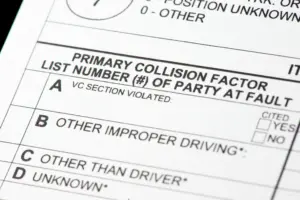
Expect a face sheet with date, time, and location; party and vehicle info; a diagram with directions of travel and impact points; an officer narrative; contributing factors and citations; and any noted injuries or EMS transports. Read it like an adjuster would: does the diagram match the scene, do stated impacts match damage, and are contributing factors consistent with the facts? If something critical is missing, like a witness phone number, ask for a supplement.
The Fastest Way: Order Online
For most people, the quickest route is the Phoenix Police Public Records portal. You’ll search by report or incident number, date and location, or party name, then pay a small fee to download a PDF. Use exact spelling and street directions (E, W, N, S) to improve matches. If your case was handled by a state trooper on a freeway, try the Arizona DPS Records Request Portal instead.

You’ll Need:
- Report or incident number (best), or crash date/time and precise location
- Your name and contact info
- Proof you’re a party or representative (you can upload it during the request if asked)
Pro Tip: Save the PDF with a clear name and date like (Ex. Phoenix_Crash_Report_2025-03-18_Last Name.pdf) and back it up.
If the Portal Says “No Record Found”
If the portal does not find any record of the accident, don’t panic, this usually means the report isn’t uploaded yet or your search terms don’t match the case fields.

Try this, in order:
- Search by the incident/report number only (no names).
- Expand your date range and double-check street prefixes and directions.
- Wait 2–3 business days and re-check.
- Call the Records Unit with your incident number to confirm status or to see if a basic face sheet is available now. Phoenix PD’s public records page lists the latest contact details and hours.
If your crash happened on a freeway and DPS investigated, the report may be posted through the state Arizona DPS Records Request Portal instead of the city portal.
Alternative Ways to Get Your Police Report: In Person or by Mail
Prefer paper, or need a raised-seal certification? You can request at the counter or by mail through Phoenix PD’s Public Records and Services page, which lists current hours, address, and contact details. Certified copies cost a bit more and take longer to prepare.

Bring or Include:
- Government-issued ID
- Report/incident number (or date/time/location)
- Proof of involvement (registration, insurance card, or an authorization if you’re a representative)
- Payment in an accepted form (check the page above for fee and payment options)
Typical Timelines in Phoenix

- Minor-injury or property-damage crashes: reports often post within 7 to 14 business days.
- DUI, hit-and-run, or serious-injury cases: expect longer, because specialized units add supplements and some attachments can be held until related criminal matters advance.
When a report is pending, you can still start repairs and medical care; insurers will usually proceed with photos, estimates, and your statement while the report uploads. Phoenix’s records page notes how to contact the unit for status updates
How Much Does a Phoenix Police Report Cost?
Online PDFs are a flat, modest fee around $5, but paper and certified copies may be priced per page plus a certification charge. If you need a court-friendly certified copy with a stamp or seal, you just need to request a “certification” when you submit your order or at the counter. Details and current options are listed on the city’s Public Records and Services page.
How to Request a Correction or Supplement On Your Phoenix Police Report

If you spot a factual error, ask for a supplemental report. Be precise about the line you’re correcting and include evidence such as intersection photos, a witness statement, or medical intake notes from the same day. In cases such as these, it is highly recommended to be detailed as possible, so there is no confusion in the correction. For example, here is a simple script you can use in writing or an email:
“On Page 2, Vehicle 1 is listed as southbound. I was westbound on [Street]. Attached are two photos taken at the scene showing my vehicle facing west and the posted lane arrows. Please issue a supplemental report reflecting this correction.”
Submit your request through the contact options on the city’s Public Records and Services page so it’s routed correctly.
When Statewide Police Reports Make Sense
If a DPS trooper wrote your report which is common on I-10, I-17, Loop 101, and other state routes, order through the Arizona DPS Records Request Portal. It’s the official channel for reports written by state officers and can be faster than waiting for inter-agency transfers.
Need Help With Your Accident and Getting Your Report?

If dealing with portals, redactions, and insurer requests feels like a second job, our Phoenix car accident lawyer team can take it off your plate. We will order your report, track supplements, correct errors with evidence, and present a clean claim package that insurers take seriously. You focus on medical care. We handle the paperwork, proof, and negotiations.
To schedule a FREE consultation, call 213-927-3700 anytime or complete our easy online easy online contact form.
The post How to Get a Phoenix Police Accident Report (Step-by-Step Guide) appeared first on West Coast Trial Lawyers.